Question (Shortened to simplify):
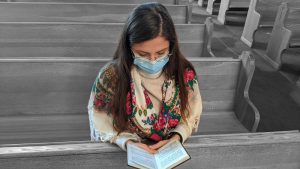
In COVID-19, how do I learn more about the Ukrainian Catholic Church? Last year I attended the Armenian Apostolic Church (was across the road) and was invited to receive communion and my confessor said yes. I don‘t want to give up my RC confessor or receiving communion at the university. I spent hours praying in an eastern rite church with 800 icons when on vacation. But I would like to participate more fully. Can I be in both Eastern and Western churches? For me, it is comfortable and more complete.
Response from: Fr. Jim
Response:
Thank you for your question. During this time of the pandemic, online resources about the Ukrainian Catholic Church are plentiful. There are many services being live-streamed on Facebook and YouTube, along with bible studies and discussion groups exploring various themes about our faith. The best place to start to learn more about the Ukrainian Catholic Church is to start with the Catechism of the Ukrainian Catholic Church: Christ – Our Pascha. It can be found in its entirety at Royal Doors: http://catechism.royaldoors.net/catechism/ . Other great resources would be to check our website (https://eeparchy.com) or other Ukrainian Catholic eparchial websites and read about the resources and programs that they offer online.
Regarding your second question, it is okay to participate in any of the 20 churches of the Catholic communion (19 of these are Eastern Catholic Churches, the other is the Roman Catholic Church). However, you only officially belong to the church into which you were baptized. It is possible to change your membership (the canonical term is “ascription”) by petitioning the local bishop, but, until his authorization, you will remain a member of the church of your baptism, whether that be Roman Catholic or Ukrainian Catholic. Of course, you are always welcome to attend services and learn more about the various Eastern Catholic Churches as part of your spiritual growth within the fullness of the Catholic faith. May God continue to bless your journey!
Thanks.
In Christ,
Fr. Jim
Listen to our podcast here:
Discover the Saints in Our Lives here:
Learn Our Faith Here: