In March 2027, Canada is scheduled to expand access to Medical Assistance in Dying (MAiD) so that people whose only underlying condition is a mental illness will be eligible for euthanasia and assisted suicide. This change would treat mental illness itself as a “grievous and irremediable” condition, even though suicidal thoughts are often a symptom of illness and many people go on to recover when they finally receive the care they need. Serious gaps in Canada’s mental‑health system—long wait times, limited access to psychiatrists, uneven services—mean that some may be drawn to MAiD because the system has failed them, not because death is the only remaining option.
Bill C‑218 – “The Right to Recover Act”
Private Member’s Bill C‑218, The Right to Recover Act, seeks to amend the Criminal Code so that a mental disorder is not considered a “grievous and irremediable” condition that can make someone eligible for MAiD. If adopted, this Bill would permanently prevent the planned 17 March 2027 expansion of MAiD to individuals whose sole underlying condition is mental illness.
Help Not Harm: What is Bill C‑218?
The Canadian Conference of Catholic Bishops (CCCB) has publicly and strongly endorsed Bill C‑218, calling it “an important and necessary step to protect vulnerable persons from the expansion of euthanasia and assisted suicide”. The Bishops stress that offering death as an option to those who are mentally ill undermines efforts to prevent suicide and sends a painful message that some lives are no longer worth living.
CCCB statement: https://www.cccb.ca/media-release/cccb-statement-on-bill-c-218-no-maid-for-mental-illness
Why Bill C‑218 matters
-
Every life is precious. As Catholics, we believe in the sanctity of every human life, from the moment of conception to natural death.
-
A desire to die can be a symptom of illness. Suicidal thoughts are frequently part of mental illness itself, which raises serious concerns about whether consent for MAiD can ever be truly free and informed in these situations.
-
Mental illness is often treatable. Many mental‑health conditions improve with appropriate therapy, medication, community support, and time; numerous people living with mental illness do recover or find new stability and hope.
-
Gaps in mental‑health care remain unresolved. Long waits, limited specialist care, and uneven services mean that some people consider ending their lives because they cannot access the help they need. This is a failure of care, not a justification for assisted death.
-
Vulnerable Canadians face a greater risk. Those living with mental illness are more likely to experience poverty, trauma, isolation, disability, or lack of support—factors that can increase pressure towards assisted suicide rather than making it a truly voluntary choice.
A key second‑reading vote on Bill C‑218 is expected in mid‑April 2026, which makes the coming weeks a crucial time for Catholics and all people of goodwill to speak up.
Support Bill C‑218
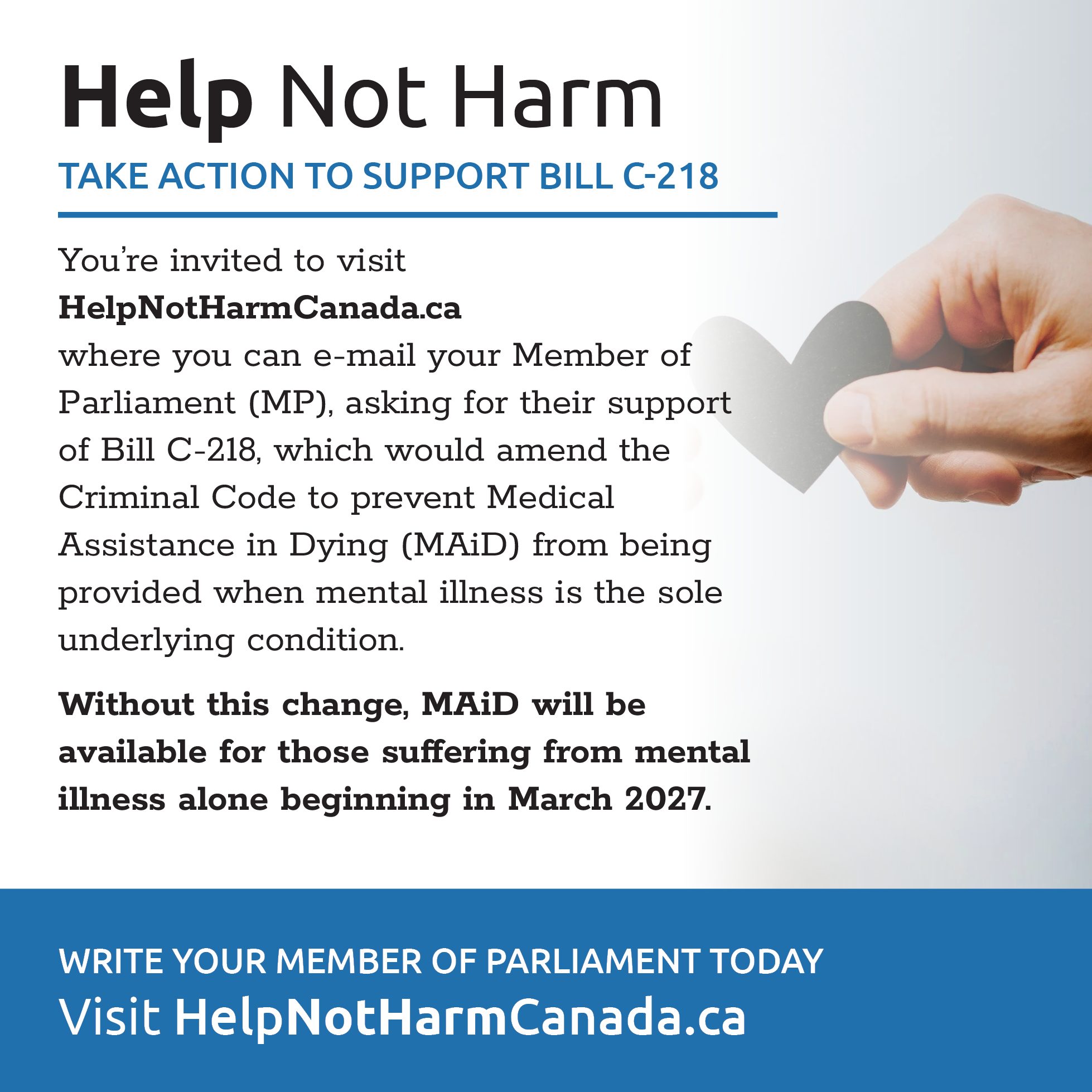
Visit https://www.helpnotharmcanada.ca/ and use the simple tool to send a letter to your Member of Parliament in support of Bill C‑218, The Right to Recover Act, asking them to stop the expansion of MAiD for mental illness alone.
The Eparchy’s position
In communion with the Canadian Conference of Catholic Bishops, our Eparchy fully supports Bill C‑218 and opposes the expansion of MAiD to those whose only underlying condition is a mental illness. As Ukrainian Catholics, we profess that life is a gift from God and that only God is Lord over life and death; we are called to protect life, to accept God’s will in our dying, and to accompany one another with compassion rather than to hasten death.
Extending MAiD to mental illness alone risks normalising assisted death as a form of “treatment” for psychological suffering. Instead, we insist that those who live with mental illness deserve timely, effective, and compassionate medical, psychological, social, and spiritual care, and the real possibility of recovery—“the right to recover,” as the Bill’s title reminds us. As an Eparchy, we commit ourselves to prayer, pastoral care, and public advocacy for those tempted to despair, and we urge governments to invest in support and prevention rather than in the means of death.
“Help Not Harm” – a national Catholic campaign
To help Catholics respond, the Archdiocese of Toronto, in collaboration with the CCCB Office for Family and Life, has launched a national, bilingual advocacy campaign called “Help Not Harm.” Through the website https://www.helpnotharmcanada.ca/, individuals can register and automatically generate a respectful letter to their Member of Parliament, urging support for Bill C‑218 and calling for a halt to the expansion of MAiD for mental illness alone; copies are also sent to the Prime Minister and the Minister of Justice.
Key features of the campaign include:
-
Website available in English and French: https://www.helpnotharmcanada.ca
-
Language that allows participation by non‑religious partners, including mental‑health and disability groups.
-
Compliance with anti‑spam laws: users must opt in, and email addresses are not used for fundraising or unrelated communications.
-
The main campaign window runs from March to mid‑April 2026, before the next vote on the Bill.
A call to prayer and action
We invite all clergy, religious, and lay faithful of our Eparchy to join in prayer for those who suffer with mental illness, for their families, for mental‑health professionals, and for our legislators. We encourage parishes to share information about Bill C‑218, to accompany those in distress, and to witness to the truth that every human life, no matter how wounded, remains precious in God’s eyes.
We also urge you to take concrete action.
Support Bill C‑218
Visit https://www.helpnotharmcanada.ca/ and use the simple tool to send a letter to your Member of Parliament in support of Bill C‑218, The Right to Recover Act, asking them to stop the expansion of MAiD for mental illness alone.
Offer help, not harm, to those in crisis
If you or someone you know is in immediate danger, experiencing a mental‑health crisis, or having thoughts of suicide, call or text 9‑8‑8 right away (available 24/7 in Canada and the United States) to connect with a trained crisis counsellor.
As followers of Christ, we accept God’s will over life and death and acknowledge that only He has the ultimate right over our dying. We are called to stand with those who suffer, to defend the dignity of every human person, and to choose care, accompaniment, and hope over any path that intentionally ends human life.
Will you take a moment today to visit https://www.helpnotharmcanada.ca/, add your name in support of Bill C‑218, and witness that we seek help, not harm, for our brothers and sisters living with mental illness?